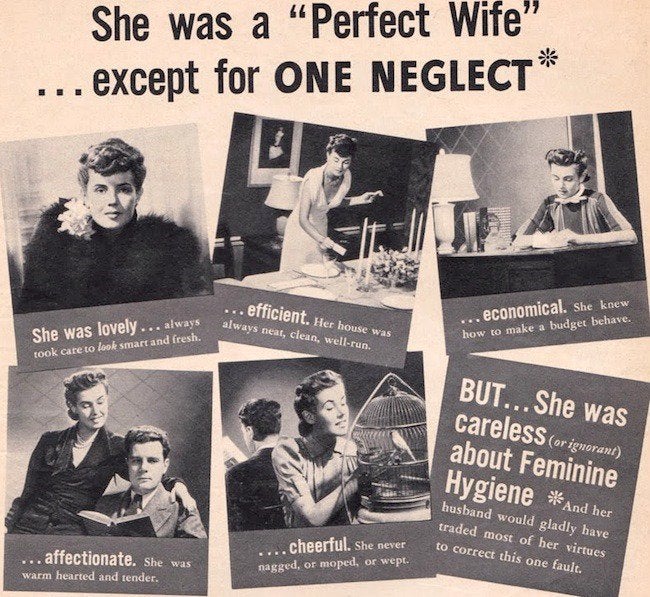
The visual media I have chosen to analyze is this 1950s advertisement for feminine hygiene. The tagline reads, “She was a ‘Perfect Wife’… except for ONE NEGLECT*”, followed by a series of cards, 5 of which display a black and white image with a caption, and each describing a virtue of this “Perfect Wife”. The first box says, “She was lovely… always took care to look smart and fresh”, paired with a picture of a woman with her hair and makeup done, all dolled up and draped in a fur coat. The second frame continues the previous ‘she was lovely’ statement with “[..] efficient. Her house was always neat, clean, well-run”, and another picture of the same woman in another fancy outfit, daintily placing place-settings on a candle-lit table, presumably for dinner. The third frame says, “[..] economical. She knew how to make a budget behave”, accompanied with our “Perfect Wife” sitting at a table with a bunch of papers, apparently writing out her budget so that her spending costs don’t go over the allowance her husband has given her. The fourth frame says, “[..] affectionate. She was warm hearted and tender”, with “Perfect Wife” now draping herself over her constipated-looking husband as he (attempts) to read a book. The fifth frame says, “[..] cheerful. She never nagged, or moped, or wept”, and “Perfect Wife” there in the picture cooing over a songbird in a little hanging cage, while her (still constipated?) husband’s back and newspaper adorn the background space. And finally, the last frame really digs that nail in with, “BUT… She was careless (or ignorant) about Feminine Hygiene *And her husband would gladly have traded most of her virtues to correct this one fault.”
There is so much wrong with this advertisement. Interestingly enough, the ad actually doesn’t name any brand or company promoting this, but more just speaks to their belief that hygiene is the best attribute a woman can have. However, the issue with this is not about hygiene itself- it’s perfectly fine to want to smell clean, feel clean, etc. The problem (actually one of the many- but perhaps the most over-arching one) is that this advertisement is aimed, not at women for their own hygiene, but at men and more specifically, husbands of women. Why on earth is this trying to sell something not to the people who would presumably be using it, but instead, their husbands? Well, I have an answer for you: I think the fact I mentioned earlier that there is no actual product name or brand name on this ad speaks to its true purpose. It’s not trying to sell literal hygiene products, it’s selling into people’s minds the notion that women, and wives, are nothing more than props placed in front of the backdrop of the ‘perfect home’, to act as homemakers and caretakers and to be beautiful and dutiful and to cater to the men in their lives as nothing more than a mindless robot (a Stepford wife, if you will). And yes, to fucking smell nice. Because if they don’t smell nice, what kind of pleasure would that give their husband?
This is that Hard Gender Essentialism that prevailed in and around the 1950s during the Industrial Era of the United States. It’s interesting to note how in every image of our “Perfect Wife”, she is seemingly always in a house or at least clearly ingrained into this Cult of Domesticity. It’s not ‘their house’, it’s ‘her house’, because it’s her job to keep it “neat, clean, well-run” and this ability to do so is what defines her as being ‘good’. I mean, this ad has got the whole caboodle. She’s “lovely- she looks smart and fresh”. She keeps her expenses down. She’s affectionate and cheerful. See? She’s happy in her little cage. She likes it in there. And not one of these virtues listed implies anything about the substance of the woman herself or that she would do anything just for her or to make herself happy. No, all of the things that make her useful are ways in which she can serve others, mainly Mr. Might-be-Constipated.
Then the fantastical final blow of this series of sexist and misogynistic cards is that little asterisk that denotes her “ONE NEGLECT” as something her husband “would gladly have traded most of her virtues to correct this one fault”, which is such a weird slight to all these other attributes that do make her desirable. But I suppose he said ‘most of her virtues’, so she could still make him dinner and stuff and smell nice. The one panel I struggled with, however, is the budget one. It says she can ‘balance her budget’, which would mean that she can do basic algebra, and math is a skill I had thought would, at the time, have been one that was generally aimed towards men. You know, because what could a woman do with that kind of information if she’s just going to be locked in the house all day anyways? And then the advertisement says that this husband would rather his wife smell nice than have the ability to add and subtract. Yikes. Just yikes.
It’s also very interesting to note that this ad features the phrase ‘feminine hygiene’. Not just ‘hygiene’, ‘feminine hygiene’. As if women need different cleansing products than men. Seriously, I have never before heard the phrase ‘masculine hygiene’. Have you? No! Because for men, it’s just hygiene. And this is something that still, some 70 years later, is still used as a marketing ploy to sell hygiene products. “You want a bar of soap? Oh, that’s $1.99. You want a bar of soap and you’re a woman? Hey, here is this special soap that was made specially for women because it has special ingredients that will make your vagina smell like daisies and get rid of all your disgusting body hair and also its pink. That’ll be $20.” Out of all the things on this advertisement, that’s probably the one aspect that would be the same on an ad today. However, while we would never see an ad today that states these antiqued gender laws so explicitly, there is still some of this expectation that women must be “lovely, affectionate, cheerful” and that they belong in the house, taking care of the husband and kids that still exists . Women are in the workforce now, but are grossly overrepresented in jobs like elementary school teachers, librarians, nurses, receptionists, and dental hygienists- fields that involve nurturing, assisting, taking care of, etc. Women have to deal with sexual harassment and sexually hostile work environments that interfere with their job performance. They hit the glass ceiling on the promotional ladder because they’re just ‘working because they want to’ and ‘men are the ones who actually need this’. They are sidelined by the glass escalator because men are ‘just better leaders’. They’re expected to run the ‘second shift’ while their husbands turn on the TV and grab a beer. They’re [white women] paid 80 cents to a man’s dollar (and women of color are paid even less) because, God even knows. Men just do it better? There’s so many justifications. The patriarchy has a lot of explanations as to the reason of oppression.

 From the Fish in the Fishbowl