“They cannot represent themselves; they must be represented.” -Karl Marx
This paper seeks to understand Orientalism at the Disneyland park and how the Orient is constructed through various Disney media. This is important because, like all nonwhite races, the Orient and the people in it are constantly portrayed, viewed, and treated as secondary members of society and, historically, have been persecuted as such. As the Western world came to dominate the Earth, so also did Europe and the colonialist mindset come to take up the narrative of the Orient and appropriate thousands of its cultures. Social theorist Edward Said illustrates a complex relationship of power and domination between the Western world (the Occident) and the Eastern world (the Orient) and how the Orient has been constructed as the ‘Other’ by the ethnocentric, European hegemony. This can be applied to my project using the concept of Orientalist fantasies and the ways in which the Orient is constructed by the West for material investment, with no word or thought for the real people and places it is exploiting. In addition, I will draw from Laura Mulvey’s “Visual Pleasure and Narrative Cinema” which will help depict the intersection of the Orient and women, with the scopophilic male gaze playing as much of a role as the white European in the conversation of Orientalism. This will be achieved through fieldwork at the Disneyland California Adventure park of Mulan’s Lunar New Year Procession and Celebration as well as additional research of various Disney films depicting the Orient, such as Aladdin, Mulan, and Lady and the Tramp.
In the decades that the Walt Disney Company has grown and thrived, it has spread its branches to reach the throes of Hollywood, to stand as a ubiquitous force in the merchandising market, and has come to dominate the landscape of international amusement parks. The relationship between Disney and the Orient, or the Occident and the Orient, can be made sense of by recognizing it as a culture of domination. In it, the European hegemony maintains an ethnocentric ideology that the European identity is superior to all other non-European peoples and cultures and uses it to exert control over the Orient through dehumanizing ideology and Orientalist fantasies. The Orient is ‘Otherized’ and exoticized by Western media and its narrative is taken up to depict it as not a free subject of thought and action, but a shell of a culture that can be studied, depicted, and reproduced for the financial and symbolic capitalist advantage of the white man (Said 1978).
LIGHTS, CAMERA, STEREOTYPE
For decades, cinema has been one of the most pervasive forms of creating and perpetuating cultural and ethnic stereotypes, and the Orient is no exception. The Disney empire’s grasp on Hollywood and the entertainment industry is a firm one, and with the recent acquisitions of properties such as Pixar, Lucasfilm, Marvel, and National Geographic, Disney has monopolized a very large space of American entertainment. This follows that Disney is influential in its characterizations and productions, with cultural stereotypes being no stranger to Disney’s creative content. The Orient is depicted in classic Disney films such as Mulan (1998) and Aladdin (1992), while specific characters meant to portray members of the Orient appear in The Aristocats (1970), Lady and the Tramp (1955), Fantasia (1940), and Tangled (2010). It would be prudent to begin an analysis of these films by stating that Disney is a machine of racism and each and every one of these Orientalist ‘representations’ are problematic, racist, and offensive and contribute to the wider realm of institutional racism, discrimination, prejudices, and persecution.
One of the main ways in which this racism is brought to the films is through the Orientalist fantasy. Characters and locations are constructed as illusions of reality, or a simulacra, in which the Orient is depicted as idealized images with exoticized cultures, and none do it quite as blatantly as in Aladdin (Baudrillard 1988). It begins in the opening credits with the now instantly-recognizable drum and chiming over a frame of red fire and a wisp of pink smoke that twists and coils its way up the screen like a serpent in the sand. As the music leads into a mystical tune, the lyrics offer more to the imagery to the scene- “Oh, I come from a land, from a faraway place, where the caravan camels roam. Where it’s flat and immense and the heat is intense; it’s barbaric, but hey, it’s home” (Aladdin 1992).
As the names of all the white men who created and produced the film fade on and off the screen in curvy, gold embossed calligraphy, we watch as a trudging camel and its passenger lumber across the sand and reach the fictional city of Agrabah, featuring the Sultan’s Taj Mahal-inspired palace against the backdrop of a vibrant pink and purple sunset and a shot of an almost-nude man performing fire breathing and as he shoots flames across the screen, we are brought back to the camel and its rider, the latter of whom goes on to introduce and narrate the story. In just these first 60 seconds of the film, the Orient is already so clearly established and given imagery and characteristics that will remain motifs and themes throughout the film. By all means, this is what the filmmakers intended and is good filmmaking and storytelling strictly from a cinematic perspective. The issue therein lies the fact that the symbols they’ve established rely exclusively on stereotypes and an overall homogenization of the Orient.
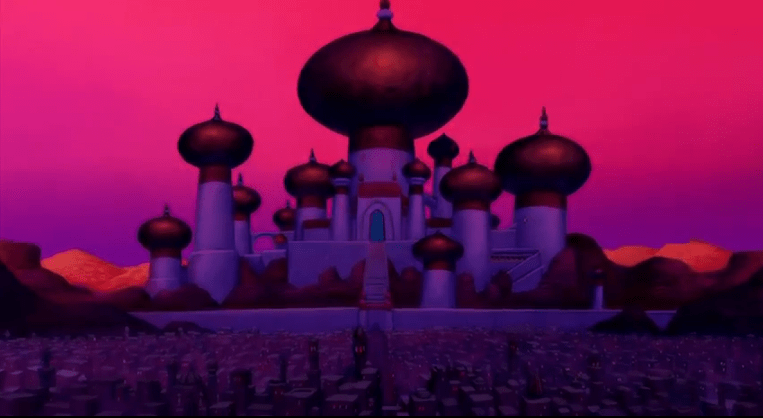
The motif of fire and smoke as well as the presence of the omnipotent, wish-granting genie and the villain’s flair for magic and eventual transformation into a sorcerer and genie reinforces an overall illusion of mysticism and magic in the Middle East. The intensely vivid color palates of the landscapes and buildings also create a simulacrum of Arabia (the intended location of Agrabah) where everything from the glowing sky to the shops on the street are intensified to create a reality that is no longer real (Baudrillard 1988). It is now the hyperreal- and no allowance is given for the viewer to interpret anything other than the colorful and enchanted land of Agrabah (Eco 1990).
Aladdin also prevails in the blending of Oriental cultures. Agrabah, as previously mentioned, is meant to be located in Arabia near the Jordan River and yet the Sultan’s palace is representation of the Taj Mahal in India and Jewish and Hebrew phrases like ‘shalom’ are used when the language spoken in Agrabah should be Arabic (Aladdin 1992). The Orient is subsequently amalgamated into a single simulacra and in doing so, dehumanizes the true Orient and the people in it (Baudrillard 1988). In creating these representations of the “Oriental”, the human being is obliterated and is no more (Said 1978). This thoughtless conflation of cultures, customs, and languages is dangerous in the perceptions and messages the targeted Western audience perceives. The very existence of these representations of the Orient as one single, fluid culture in which the lines and differences do not matter very much makes clear the Eurocentrism and white privilege of the creators and the consumers. This is, of course, due to the fact that the portrayals of the Orient by the Walt Disney Company were never intended to be for the Orient or even to be accurate. Films like Aladdin and Mulan are stories of the Orient that are made not for the Orient, but for the West. The European and American hegemony has taken up the narrative of the Orient and constructed it into a material investment in which the culture is commercialized and the capitalist elites make money off of the cultural appropriation (Said 1978; Adorno and Horkheimer 1947).
Further constructions of the Orient and Oriental characters are made in The Aristocats and Fantasia. In Fantasia, The Nutcracker Suite by Pytor Ilyich Tchikovsky features a “Chinese” dance and in the accompanying animation, seven pink mushrooms dance around to the fast-paced, string-heavy music. The tops of the mushrooms resemble dǒulìs and they appear to shuffle about in floor-length hanfu garments with their ‘arms’ folded in front of them, repeatedly bowing to one another. Though they technically have no faces, straight lines are drawn on the fronts of the mushrooms that are direct depictions of the all-to-common squinky-eyed portrayals of East Asians in the Golden Era of Hollywood. Another musical number in The Aristocats contains a Siamese cat (named Shun Gon the Chinese Cat) using a symbol as a dǒulì and later playing the piano with chopsticks while screeching in a Chinese accent, “Shanghai, Hong Kong, Egg Foo Yong! Fortune cookie always wrong! Hya ha ha!” (The Aristocats 1970).
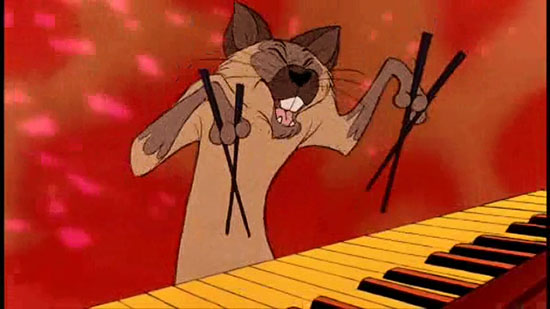
Lady and the Tramp goes even further with an entire song dedicated to racist Chinese stereotypes. This time, there are two Siamese cats, named Si and Am, who are minor antagonists and act as creepy nuisances to the heroine Lady. Their introduction song, entitled “The Siamese Cat Song” opens with the sound of Chinese gongs and plucked notes while the eponymous twin cats, both sporting the squinty eyes, dance around in slinky and staccato movements, all while wreaking havoc on the peaceful, domestic, white-picket-fence home of Jim Dear and Darling. All three of these Siamese cat characters are performed with a Chinese accent and voiced by white actors. Rosina Lippi Green discusses the issue with this and the fact that nearly half of foreign-accented characters in Disney films are villains (1997). This is a cyclical pattern that constantly attaches negative connotations and story lines to characters who are nonwhite and non-American, thus rewarding the white characters for their whiteness and status of a superior cultural and ethnic identity (Said 1978).
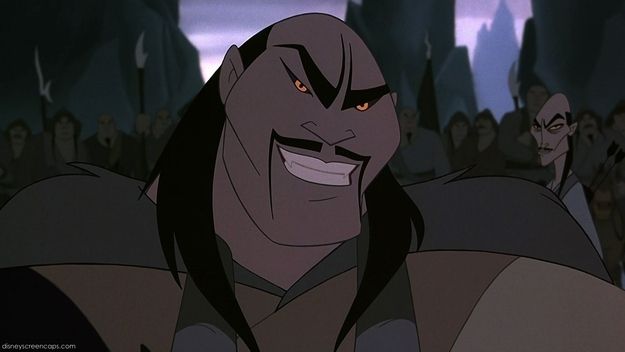
Mulan, Aladdin, and Tangled are also significantly similar in their portrayals of their villains. All three of their films’ main antagonists are introduced in the opening scenes, even before we meet the heroes. In Mulan, Shan Yu is the leader of the Hun army and Mongolian invaders of China whom Mulan eventually goes to war against. The depiction of Shan Yu and the rest of the Huns is not an attractive one, with Shan Yu himself being a hulking and muscular figure with piercing yellow eyes, grey skin, a sharp nose, prominent forehead, fingernails sharpened into claws, and always accompanied by a menacing black falcon. His character is portrayed using physical stereotypes of Mongolians and meant to induce the imagery of an ‘exotic’, Oriental man who is, at his core, evil. Aladdin’s main villain is Jafar, a narcissistic, tyrannical psychopath who revels in the torturing of others, sexually harrasses Princess Jasmine, and enforces misogynistic behavior (“Your speechlessness is a fine quality in a wife”) (Aladdin 1992). Jafar is the greedy, terroristic Arab man in Middle Eastern stereotypes. This is further stressed in the dichotomy of appearance with the film’s other characters. Though the story is meant to take place in Arabia and the characters (sans the Genie) are meant to be Middle Eastern, the protagonists instead have very Western features, with big eyes and light skin, while the villain is portrayed as more similar to the physical appearance of Middle Easterners and heavily playing into Arab stereotypes.
Tangled’s main antagonist is Mother Gothel, who, though appearing paler than the white protagonist Rapunzel, is a victim of racial coding, wherein she is given traits and physical attributes typically associated with a certain group of people without it actually being stated that she is of that particular race. With Gothel’s hooked nose, sharp features, dark eyelashes, and dark and kinky hair, some online Disney fans believe she is Italian, Armenian, or Jewish. These physical characteristics, combined with her overbearing personality, have led some to believe she is a play on the Jewish mother stereotype. She is encoded and decoded with stereotypes to create palpable and easily recognizable images that influence the viewer without their knowledge (Hall 1973).
In any case, it is clear that Gothel is not supposed to be white, especially when her vain, selfish, abusive, and ethnic-looking character is subconsciously juxtaposed by the viewer next to the beautiful, soft-faced, golden-haired feminine ideal of white beauty in the heroine of Rapunzel (Tangled 2015). The issue with these films is not that the villains are diabolic and evil, but that they are portrayed as ethnic-looking, “Oriental” characters that look remarkably different from the protagonists. The films, which were all made by white people, are illustrations of the West’s stereotyping of the “East” as signifying danger or a threat and the racial encoding of self vs. the Other, Occident vs. Orient (Said 1978; Hall 1973). In it, the Orient is the Other and is separated from the true heroes and subjects of the story, who, though some are technically also meant to be people of color, come to represent the whiteness that will always prevail, always be the hero, and always triumph over the evil (the nonwhite) (Said 1978).
IT’S THE MOST RACIST PLACE ON EARTH
One of the hallmarks of Disney’s monetary and branding success is the translation of their films into physical manifestations, generally through merchandising and product placement as well as the iconic international Disney resorts. For about three weeks in late January and early February, the Disneyland park puts on Mulan’s Lunar New Year Celebration as a gesture meant to honor the Chinese, Korean, and Vietnamese Lunar New Years. For these few weeks during an annual low peak in tourism, a large section of Paradise Pier in the California Adventure park is decked out in “Oriental” garb and decor, beginning with the welcoming Lunar New Year gate, fully dressed in red and gold lanterns, banners, and of course, Mickey heads. This year, the Lunar New Year celebrates the Year of the Mouse, meaning that an extra level of focus is placed on the Mickey and Minnie imagery and silhouettes.
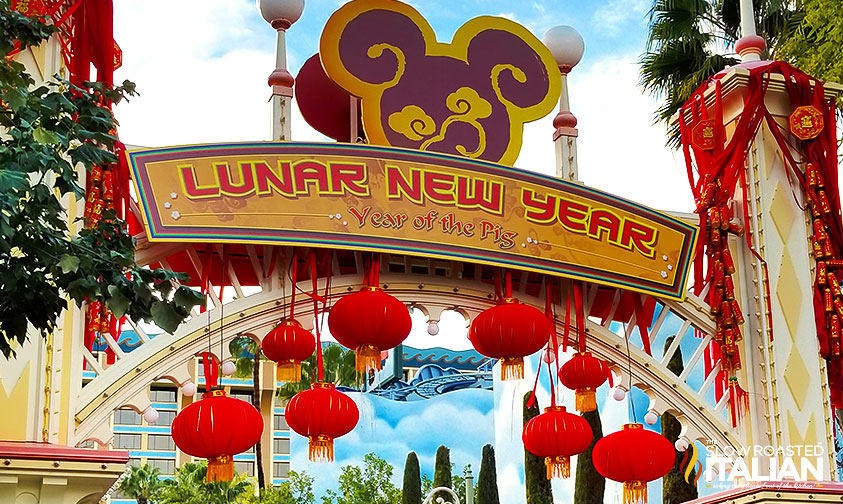
The centerpiece and main spectacle of Disney’s Lunar New Year celebration is Mulan’s Lunar New Year Procession, which takes place four times a day along the festival corridor from Paradise Gardens to Paradise Garden Walk. The procession features the familiar gang of Mickey, Minnie, Goofy, Chip, and Dale as well as Mulan and Mushu, the latter of whom is generally an extremely rare character to find in the park. They are joined by an entourage of cast members of East Asian descent with the men dressed in traditional mandarin-style clothes carrying introductional banners and the women in hanfus and tight buns wielding Chinese parasols. The rest of the cast is made up of performers from China who are part of an exchange program the Disneyland park does with its international parks in Hong Kong and Shanghai, and who give demonstrations in martial arts and perform the traditional dragon, ribbon, and fan dances (Joy 2020). The procession is introduced by a disembodied male Chinese voice who also offers commentary throughout the show. The performance is kicked off with the timbers of drums and gongs and the plucked notes reminiscent of the “The Siamese Cat Song” that offer the melody as the procession parades down the corridor and reaches the stage. As the dancers sway and march to the opening segment, the fur characters (Mickey, Goofy, etc.) traipse around the stage in typical cartoon character performance and Mulan stands front and center, extending her leg to resemble a ballerina, placing a hand gingerly on her collarbone and waving prettily to the crowd.
Already the performance has a lot to unpack- the show’s inclusion of true Chinese citizens may seem like a step in the right direction, as it offers a more realistic look into what these festivities and traditions celebrated by the culture look like. However, the issue that arises is that for American park goers, this act of witnessing a “Disneyfied” Lunar New Year celebration creates an illusion that one has truly traveled to China or Vietnam or Korea and witnessed an authentic Lunar New Year, but that is obviously not the case (Sorkin 1992). The fantasy that one has traveled and become more cultured is not the reality, which is damaging to the way Americans will then view the culture.
The choice to involve performers from China also turns the area into a transnational space, creating new spatial transformations and territorial relationships (Lawrence and Low 1990). This realm of global space with the flow of goods, people, and services across borders is a direct lead-in to the deterritorialization of space, as evidenced by these performers. Cultural practices are becoming severed from their native places and, per the American ethnocentrism currently prevailing as the dominant ideology, attention is given not to the original and true culture and traditions, but to the Americanized and “Disneyfied” versions of it (Budd and Kirsch 2005). Consequently, the entire show is a representation of Chinese culture and nothing more; what we are witnessing is no longer authentic- it has become an imitation (Gable and Handler 1996).
The version of Mulan offered in the Lunar New Year celebration is also a far cry from the one presented in the original film, as the characterization and the women portraying her are forced to “princessify” themselves to fit in with the rest of the Disney princess brand. Throughout the show and whenever Mulan is seen in the park (generally only ever in meet-and-greets – Mulan has not been featured in any Disneyland parade since the Mulan movie tie-in Parade in 1999), she is dressed in her fancy, traditional hanfu that her character wears to the matchmaker in the film. She only wears this particular gown for about 15 minutes at the beginning of the film, as it represents the oppression and lack of choice she has about the prospect of marriage. Yet, in all of her park depictions (sans It’s A Small World, but that has its own issues), she is dressed in it. The outfit she actually wears for most of the film and is more representative of her and her story is the Ping clothes and armor she wears to war. This version of Mulan was once in the Disneyland park when the film was first released, but due to complaints from guests saying that they couldn’t stand the woman, nay, the princess, dressed in men’s clothes, Disney chose to remove that version of Mulan altogether and dressed her in the more fancy and feminine gown seen today (Robbie 2020).
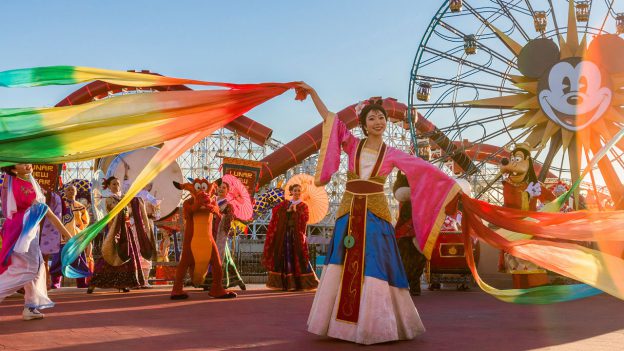
In terms of demeanor and performance of the character, Mulan, as well as all of the Disney princesses, are forced to adopt the Feminine Touch, in which every movement of their bodies is soft and delicate and everything they interact with is not held in a practical manner, but with a gentle (and weak) caress (Goffman 1979). The young women portraying the princesses are also coached to stand, walk, and pose in certain ways, implementing the Head and Body Tilt and the ‘dancing girls’ strategy (Bell 1995). When watching any given princess pose for a picture, you can see the Head and Body Tilt in action, as the women literally tilt their heads and bodies, often clasping their hands together next to their faces. It’s a subtle, implicit action that is not easily recognizable but is picked up by our subconscious that depicts women, and specifically soft and docile princesses, as unstable, off-balance, and in need of physical support.
Princess character performers are also taught to stand on one leg, with the other extended outwards from their body, foot arched and leg straightened to elongate the line. Ballet dancers are taught the same thing. Elizabeth Bell argues that the language of ballet and the conventions encoded in it for spectatorship of “high” art are embedded in the bodies of young Disney women (1995). Mulan is, unfortunately, also forced to perform her gender in this way. The Mulan as portrayed in her 1998 film would never waltz about in heels with her feet arched, hands flexed, knuckles tenderly resting on her sternum, and waving to onlookers with just the tops of her fingers and yet, as I stood in the Socal January heat, I watched just that unfold before me.
The rest of the Lunar New Year performance with the Chinese dancers is also an incredibly gendered space (Lawrence and Low 1990). The martial arts demonstrations and dragon performance, as announced by the disembodied Chinese man, are meant to represent wisdom, power, and wealth while the ribbon and fan dances symbolize things like beauty, grace, delicacy, and joy. While these are all decent attributes to strive to possess, the issue arises in the fact that the ribbon and fan dancers are all women and men only appear in the martial arts and dragon sections. The ribbon and fan dancers are dressed in soft, pastel colors, wearing capes and skirts of delicate material that billow in the wind, and are decorated in ornate jewelry and hairpieces. Their choreography, matching the ‘beautiful’ and ‘graceful’ imagery encoded in the movements, is soft and balletic, with many port de bras and twirls (Hall 1973). This reinforces the male gaze with women as the objects of it; they are turned into a spectacle as something that is to be watched, observed, gazed at.
This voyeurism even goes so far to where they are not just objects, but also targets of the gaze, which is used to exact control and power over them (Mulvey 1999). This vulnerability and subjectation to the gaze turns the women into docile bodies that are used for voyeuristic scopophilia and the perpetuation of the gendered Orientalist fantasy (Foucault 1976). The performances of the fan and ribbon dancers buy into the stereotype of the ‘butterfly’, in which East Asian women are depicted and perceived as soft, submissive, and hypersexual. This is a direct contrast to the other popular East Asian female stereotype of the evil and diabolical “Dragon Lady” (Slaying 1988). In rendering these depictions of Chinese women as the calm, graceful, and dainty ‘butterflies’, Disney reinforces the stereotypes and exoticizes and eroticizes all East Asian and East Asian American women. We are then left with a constructed appropriation of gender roles and a gendered Orientalist fantasy, which are disguised into the institutions of bureaucracy (Disneyland) in order to accrue symbolic capital that will ultimately benefit the man and the white (Althusser 1970).
MERCH MERCH MERCH
Perhaps one of the greatest achievements in terms of financial prowess that Disney has accomplished is their almost uncanny ability to merchandise their products and commodify their creative content. A stroll down the Lunar New Year-clad Paradise Garden Walk is enough to tell you that. The street is lined with “Disneyfied” Lunar New Year merch stands, displaying bright red and gold t-shirts with shiny Chinese characters and Mickey and Minnie renditions clad in “Oriental” clothes, lantern pins reading “Happy New Year Passholder”, actual plastic, light-up toy lanterns, a Longevity Noodle Co. baseball cap, fan and ribbon dancer-inspired Mickey ears, and Disney LNY iPhone cases (Budd and Kirsch 2005). It may be tempting at first to think that Disney putting on this celebration as a way of respecting, appreciating, and attempting to educate people about an important event for several nonwhite cultures, but when looking at the merch stands, it’s hard not to notice that it’s really just a straight money grab and a pretty gross commoditization of cultures.
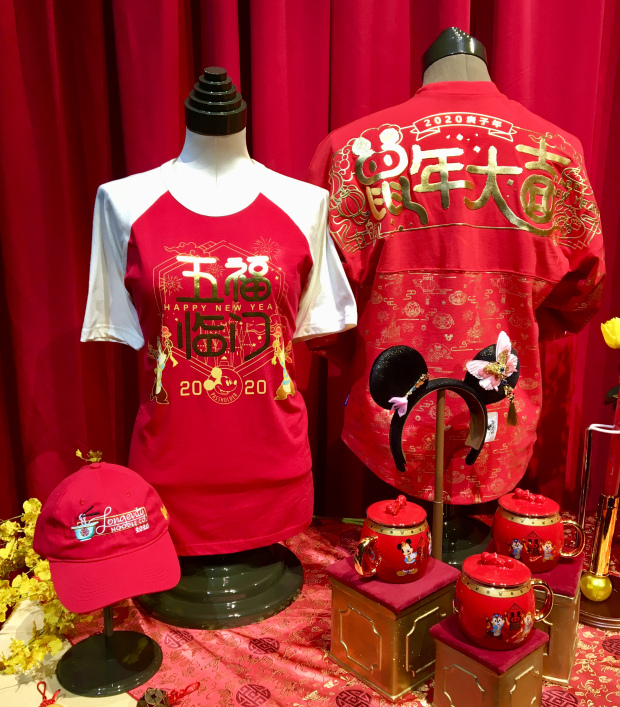
The entire concept of merchandise is a brilliant move on the part of the capitalist structure, in which products are mass-produced and reproduced to be sold to the unwitting consumer. Walter Benjamin laments that this is the downfall of artistry in America (1936). He argues that in our mass-culture society, this mechanical reproduction of products leads to a loss of authenticity. Theodor Adorno and Max Horkheimer present corresponding messages that, under capitalism, everything is uniform and the same, while simultaneously boasting their uniqueness (1947). Souvenirs are meant to be personal and unique, a special reminder of a good memory. However, according to Benjamin, once the souvenir has been mass-produced the way Disney’s has, this facade of having a unique souvenir is shattered. The culture industry instead works on commodifing nostalgia and getting consumers to buy into the experience of Disneyland, which keeps you coming back to purchase the next year’s limited edition Lunar New Year Mickey Mouse ears (Stewart 1993; Adorno and Horkheimer 1947).
However in this case, the layers of the culture industry go much deeper as these products are victims of American Orientalism and are commodified constructions of the Orient and its cultures. They reinforce stereotypes about the Orient by focusing on the imagery of things like noodles, chopsticks, lanterns, and dragons and in the unabashed slapping of Mickey’s face on their products and dressing the classic Mickey and co. characters up in traditional Oriental clothes, Disney is branding the Chinese culture as now being ‘part of’ Disney and claiming it as their own. The pretty t-shirts and trendy ‘spirit jerseys’ imprinted with Chinese characters don’t have any actual meaning to the American consumers, as most of the people buying it can’t actually read it and the packaging gives no mention as to what the shirt actually says or how to say it in Chinese. The entire culture stands as a prop for an aesthetic and the Oriental identity is constructed in this way for the interests of capitalism (Said 1978). It’s all for appearance for consumers to feel ‘cultured’ and ‘traveled’ while the capitalist elites profit off of the Chinese culture, which stems from the fact that there is a capitalist and economic base to systemic, institutional racism (Sorkin 1992). This is the power of the culture industry- it keeps consumers happy and comfortable and entertains us enough for us not to evaluate it and recognize the clear and blatant appropriation (Adorno and Horkheimer 1947).
Another impressive feat by Disney is their ability to not only merchandise their souvenirs, but also their food, and the food culture in the LNY celebration is certainly no exception. The place is decked out with their “Disneyfied” Chinese theme, featuring special, mandarin orange-flavored cotton candy at the snack carts and new food stands like “Red Dragon Spice Traders”, “Prosperity Bao and Buns”, “Lucky 8 Lantern”, and “Longevity Noodle Co.” (that one must be popular because they also made it into a hat! *available for purchase at the nearest LNY merch stand). The ‘delectable’ dishes, standing at the average Disney-level-of-tastiness, include char sui pork bao, Mickey Chinese hot dog buns, Lo Mein noodles, egg rolls, and a black sesame mochi donut to name a few. The food is undeniably Americanized versions of Oriental dishes, but the menus and presentations of the food fool people into believing that they are eating authentic Oriental cuisine. Here, another hyperreality is created, in which the fake is identified as reality, the true authentic is lost, and those in power benefit from the constructed authentic (Eco 1990; Gable and Handler 1996).

The faux Oriental food is also encoded and decoded by way of language and diction (Hall 1973). The use of words in the names of food stands like “lucky”, “dragon”, and “prosperity” draw up images of an exotic land of ‘Otherness’ and guests are invited to decode (though again, subconsciously) the stereotypes attached to it (Said 1978). The stands and carts labeled “traders” imply a mutuality in an exchange of goods across cultures, but the reality is that the Euro Colonialism that actually dictated Oriental and Occidental relations was anything but mutual. Other ‘Oriental’ eateries like the Tropical Hideaway in the all-around problematic Adventureland and the Lucky Fortune Cookery in the Pacific Wharf serve cultural dishes in a mish mash of menus. The Tropical Hideaway is described as “exotic” and “wild” on the Disney website (Disney n.d.) and serves bao (which originates in China and Indonesia), ramen salad (Japan), and lumpia spring rolls (The Philippines). The Lucky Fortune Cookery is self-described as “Pacific Rim food” and includes Japanese, Chinese, and Korean dishes.
Eastern societies and cultures are thus unabashedly conflated into one collective “Orient”. All of these details on the food alone make up the construction of the “Disneyfied” simulacra of the Orient (Budd and Kirsch 2005; Baudrillard 1988). They reinforce the idea of the Orient as a fantasy, an exotic cacophony of forgein-ness, wherein the individual cultures are indistinguishable from one another and the people are inferior to the whites, all while the Western spectators take up the Orientalist gaze with a romanticized fascination of the ‘Other’, with whom they do not wish to truly encounter and interact with, but instead to consume and in the case of Disney, to commodify them as well (Steenhuisen 2013).
FINAL THOUGHTS
As evidenced by Disney’s portrayal of the Orient, the relationship between the East and the West is a strained one- wrought with power plays, complex hegemonies, and the Occidental culture of domination. From the Lunar New Year to Arabian Nights, Disney has demonstrated its colonial-minded imperialism and control over the Orient. Karl Marx said, “They cannot represent themselves; they must be represented” (1853). This rings loud and clear when examining Orientalism at the Disneyland park. In further studies, this research ought to be expanded to the Walt Disney World Resort in Orlando, FL and the international parks in Paris, Tokyo, Hong Kong, and Shanghai. The Orlando park is much more massive than the Anaheim one and contains the controversial Animal Kingdom, Hollywood Studios, and Epcot theme parks. Analyses of the Orient would also change drastically in a park physically in the Orient like the Tokyo, Hong Kong, and Shanghai resorts.
When all is said and done, the cultural appropriation of the Walt Disney Company cannot be ignored or tolerated. There is a special arrogance and evil in those who manipulate, disenfranchise, and exploit groups of people and the Disney corporation, as well as the entire Western world, has gotten away with it for centuries. It’s high time they didn’t.
References
Adorno, Theodor and Max Horkheimer. 1947. “The Culture Industry: Enlightenment as Mass Deception,” in The Culture Industry: Selected Essays on Mass Culture. New York and London: Routledge. 2001.
Aladdin. Buena Vista Pictures Distribution, Inc., 1992.
Althusser, Louis. “Ideology and Ideological State Apparatuses.” Monthly Review Press, 1970.
Baudrillard, Jean. 1988. “Simulacra and Simulations,” from Jean Baudrillard, Selected Writings, ed. Mark Poster, Stanford; Stanford University Press.
Bell, Elizabeth. “‘Somatexts at the Disney Shop: Constructing the Pentimentos of Women’s Animated Bodies.” In From Mouse to Mermaid: The Politics of Film, Gender, and Culture , 1995.
Benjamin, Walter. 1936. “The Work of Art in the Age of Mechanical Reproduction.”
Budd, Mike, and Max H. Kirsch. Rethinking Disney: Private Control, Public Dimensions. Middletown, CT: Wesleyan University Press, 2005.
Disney. “The Tropical Hideaway.” Disneyland. Disney, n.d. https://disneyland.disney.go.com/dining/disneyland/tropical-hideaway/.
Eco, Umberto. Travels in Hyperreality. 1990. New York: HBJ.
Fantasia. Walt Disney Productions, 1940.
Foucault, Michael. 1976. Discipline and Punish: The Birth of the Prison. New York: Vintage Books.
Gable, Eric, and Richard Handler. “After Authenticity at an American Heritage Site.” American Anthropologist 98, no. 3 (1996): 568–78. https://doi.org/10.1525/aa.1996.98.3.02a00100.
Goffman, Erving. Gender Advertisements. Cambridge, MA: Harvard University Press, 1979.
Hall, Stuart. “Encoding and Decoding the Message.” The Discourse Studies Reader, 2014. https://doi.org/10.1075/z.184.210hal.
Lady and the Tramp. Buena Vista Distribution, 1955.
Lippi Green, Rosina. “Lessons from the Big Bad Wolf.” In Nglish with an Accent: : Language, Ideology, and Discrimination in the United States. London and New York: Routledge, 1997.
Low, Setha and Denise Lawrence. 1990. “The Built Environment and Spatial Form,” in Annual Reviews in Anthropology, 19: 453-505.
Marx, Karl. The Eighteenth Brumaire of Louis Bonaparte, 1853.
Mulan. Walt Disney Studios Motion Pictures, 1998.
Mulvey, Laura. “Visual Pleasure and Narrative Cinema.” In Film Theory and Criticism : Introductory Readings, 833–44. New York, NY: Oxford UP, 1999.
Said, Edward W. Orientalism. New York, NY: Vintage Books, 1978.
Slaying the Dragon: Asian Women in U.S. Television and Film, 1988.
Sorkin, Michael. 1992. “See You in Disneyland,” Variations on a Theme Park: The New American City and the End of Public Space, ed. Michael Sorkin, Noonday
Stewart, Susan. 1993. On Longing: Narratives of the Miniature, the Gigantic, the Souvenir, the Collection. Durham: Duke University Press.
Steenhuisen, Lauve. “Steenhuisen’s Musings.” Steenhuisens Musings RSS, October 21, 2013. https://blogs.commons.georgetown.edu/steenhul/2013/10/21/the-orientalist-gaze-a-conversation-with-edward-said-and-with-myself/.
Tangled. Walt Disney Studios Motion Pictures, 2010.
Tangled Part 1: Cultural Appropriation and Racial Coding. Youtube, 2015. https://www.youtube.com/watch?v=SIIUesPEJ1M.The Aristocats. Buena Vista Distribution, 1970.

 From the Fish in the Fishbowl